
Location: Fellow Robots, San Jose, CA
Timeframe: Summer of sophomore year in undergraduate
Introduction:
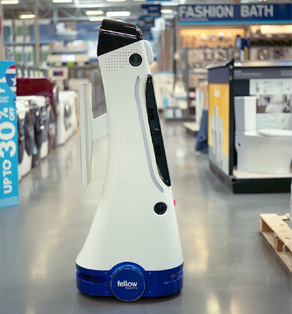
Retail automation robots improve customer experience and operational efficiency in large stores by providing inventory management and customer guidance capabilities. The objective was to create an automated robot that could interact with customers within Big Box chain stores (such as Orchard Supply or Home Depot) by guiding customers to desired items. Additionally, the robot needed a subsystem to take inventory of items within the store at different elevations and locations.
Design & Development:
My task was to test various light bars to assess which luminosity would allow the DSLR camera-based capture system to view and scan QR codes and identify items that required restocking. I also built the base of additional robots to keep up with testing demands and maintained a clean and organized testing environment.
My work included:
- Created a makeshift testing room and camera mount to simulate robot inventory tracking conditions
- Adjusted camera mount angles and distances from QR scannables to determine ideal scanning paths for the robot
- Constructed drive-trains and internal frames of the system to allow for more testing bots to be sent to on-site locations
- Reordered and re-shelved all tools, adapters, fasteners, and parts in an organized manner
Challenges I addressed:
- Quickly learning the goals and desired road-map for this robot system in American Big Box store format
- Understanding the balance of robot integration into the workforce and current human employee tasks
- Learning the importance of design to minimize cost and form factor of the robot while maximizing robustness, battery life, and ease of use
Evaluation:
The light bar testing identified optimal luminosity levels for QR code scanning across varying store lighting conditions, enabling reliable inventory tracking at distances up to 8 feet. The camera mount angle optimization improved scan success rates and reduced the need for multiple passes. By constructing additional drive-trains and frames, I enabled the team to deploy three additional test units to on-site locations, accelerating the validation timeline. The organized workspace and parts inventory system reduced component retrieval time and improved overall fabrication efficiency.
Conclusion:
This internship taught me how to rapidly prototype and test robotic systems in real-world commercial environments, balance design constraints between cost and performance, and consider human-robot interaction in workplace settings. The experience of optimizing sensor systems for variable environmental conditions has informed my approach to developing robust autonomous systems in my graduate research.
 Dhruv Lal