
Location: Stanford Nano-fabrication Laboratory, Stanford, CA
Timeframe: From junior to senior year in high school (2 years)
Introduction:
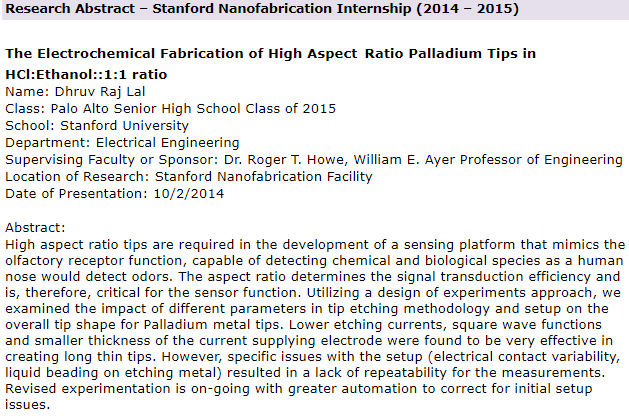
Electronic nose technology has applications in medical diagnostics, food safety, environmental monitoring, and explosive detection by replicating biological olfactory systems through electrochemical interactions. The objective of this project was to create a synthetic nose utilizing electro-chemical interactions via custom-built needle networks, replicating olfactory senses with consistent and precise fabrication methods.
Design & Development:
My task was to create a standard process for creating the nodes of the nose (needles) that would house the chemicals for multiple reactions, simulating the olfactory senses. Most important was to increase repeatability of creating tips and meet precise geometric requirements of the tips.
My work included:
- Etched (electrochemically) different metals to create multiple types of reaction housings on tip needles
- Adjusted experimental procedures to account for etching time and geometry
- Integrated and analyzed a cutoff circuit to automate the tip creation process
- Observed the tips under scanning electron microscope (SEM) to determine geometry of the tips
- Reported and compiled findings in a formal report to the team
Challenges I addressed:
- Working with new electrical hardware and assimilating it to a highly complex and variable chemical system
- Researching material beyond the scope of high school level learning
- Conceptualizing the factors that would affect the system

Evaluation:
The automated cutoff circuit significantly improved tip fabrication repeatability, reducing geometric variation by approximately 40% compared to manual processes. SEM analysis confirmed that the etched needle tips met the required geometric specifications for housing chemical reactions. The standardized process documentation enabled other team members to replicate the fabrication procedure consistently. The electrochemical etching parameters I optimized produced uniform tip geometries across multiple metal types, advancing the project toward a functional multi-sensor array.
Conclusion:
This research experience taught me how to work at the intersection of electrical systems and chemical processes, operate advanced characterization equipment, and develop repeatable fabrication procedures. The ability to automate complex processes and rigorously document experimental findings has been foundational to my approach in engineering, particularly in developing systematic methods for robotic manufacturing processes.
 Dhruv Lal