
Location: Mech. Eng., CMU, PA (16-782 Planning & Decision-making in Robotics)
Timeframe: Fall 2025
Introduction
This project develops a coverage path planner for concrete spray 3D printing, an additive construction method also known as shotcrete. Because the nozzle sprays from a standoff distance, material can be deposited directly onto pre-placed reinforcement bar networks, which extrusion-based printing cannot reach. The same property changes the planning problem: the spray spreads over a region rather than tracing the toolpath exactly, so the planner must reason explicitly about spatial coverage. Material landing outside the target boundary (overspray) wastes concrete and raises the deposited layer above its planned height, and since each subsequent layer is planned assuming a nominal slice thickness, these height errors compound over a multi-layer build.
We formulated single-layer coverage as a grid-based search. The state couples the nozzle’s position on an occupancy grid with a bitmap of covered cells, the goal is a coverage-fraction threshold over the target area, and the cost function balances path length against an overspray penalty. We benchmarked the planner against the classical lawnmower (boustrophedon) pattern and executed all trajectories in the concrete spray simulator developed in our lab, with spray radius, standoff distance, and spreading behavior calibrated to physical deposition experiments.
The problem is complementary to my graduate research on this system: my research plans nozzle orientation and velocity along a shape’s contour, while this project asks how to fill a layer’s interior.
Design & Development
Both methods start from a perimeter contour, extracted with the slicing pipeline I built in my STL Visualizer + Basic Contour Extraction project: the target mesh is intersected with a horizontal slicing plane and the resulting closed polygon is resampled at uniform arc length. The spray footprint is modeled as a 50 mm disc set by the nozzle geometry and standoff distance. The lawnmower baseline sweeps scan lines across this polygon at half the spray radius, handling non-convex boundaries through edge intersection tests and ray-casting point-in-polygon checks. It guarantees full coverage through dense overlapping passes, which is exactly its weakness: the overlap produces redundant waypoints and material accumulation well beyond one layer height.
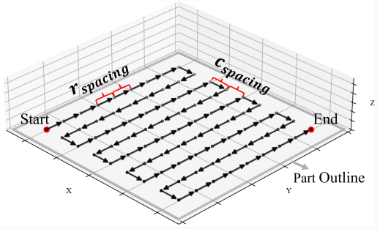
Step and clearance spacing parameters governing waypoint and pass separation.
Our planner instead discretizes the interior into a 15 mm occupancy grid, about 30% of the spray radius. A cell is free if the spray disc centered there keeps sufficient clearance from the boundary; a two-pass variable clearance scheme (a strict 0.7 spray-radius threshold, then a relaxed 0.5 pass) recovers corner cells that a single strict threshold would leave unreachable.
Searching the joint state of position and coverage bitmap is exponential in the number of cells, so we decomposed the problem into a two-level hierarchy. An outer breadth-first search greedily selects the nearest uncovered cell as the next subgoal, and an inner A* search plans to it on the 8-connected grid. Each A* edge adds a weighted overspray term to the motion cost: the fraction of 16 points sampled around the spray disc boundary that fall outside the perimeter. The Euclidean heuristic stays admissible under this composite cost, so every segment is optimal; global optimality across subgoals is deliberately traded away to keep the search tractable.
Two post-processing steps clean the concatenated path: 2-opt segment reversal removes crossings introduced by greedy subgoal ordering, and a minimum-spacing filter enforces the waypoint spacing the physical system expects. The complete pipeline plans a layer in under 300 ms.
Evaluation
We report two coverage metrics: an idealized 2D metric from the union of spray disc footprints, and an STL-based metric that classifies the simulator’s deposited point cloud as inside or outside the target perimeter, capturing spreading and settling. Height maps compare the deposited surface against the 0.02 m layer target.
On a symmetric wing geometry, the planner achieved 97% coverage while cutting STL-based overspray from the baseline’s 32% to 13% and reducing the waypoint count from 360 to 165. The greedy subgoal selection produces an emergent sweeping pattern that adapts to the shape’s contours, tightening into spiral-like motions near the curved extremities.
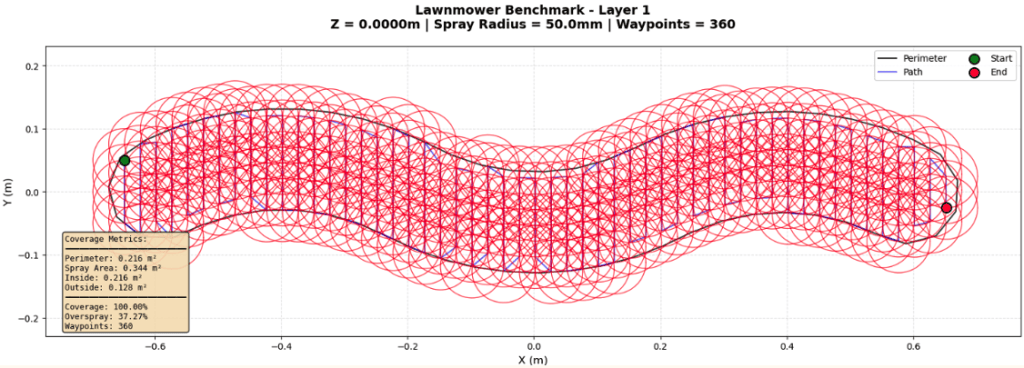
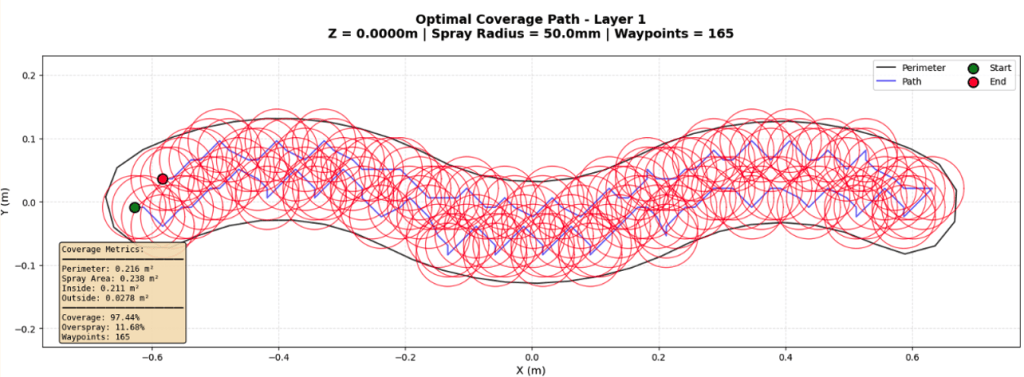
Planned paths and idealized spray footprints: lawnmower baseline (left) versus BFS + A* (right).
Height analysis shows the payoff. The baseline piles material to 0.05 m across a broad central band, while our planner keeps the surface clustered near the 0.02 m target with peaks of only 0.025 m. The remaining 3% of coverage sits at tapered extremities too narrow for the spray disc under the clearance constraint, and the deposition analysis shows natural concrete spreading partially fills those regions.
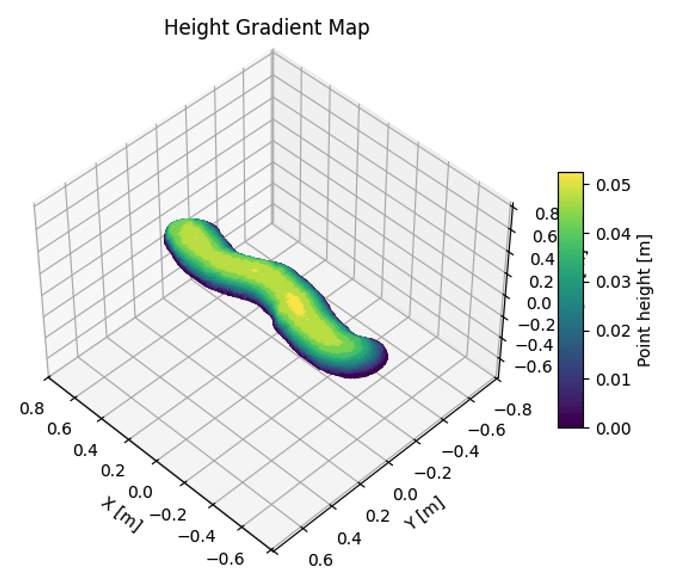
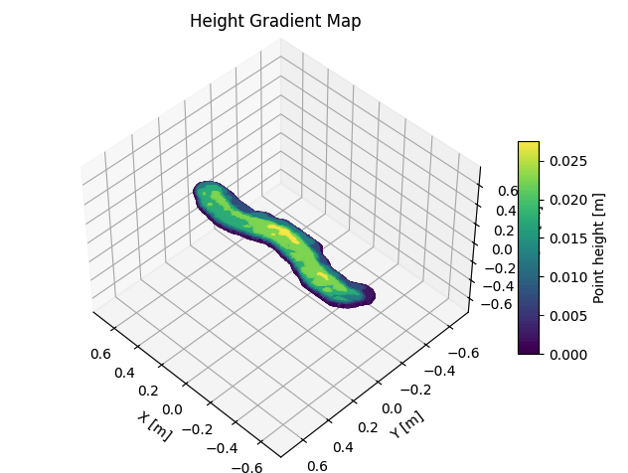
Simulated deposition height: baseline (left) versus BFS + A* (right) against the 0.02 m layer target.
A second-layer experiment tested multi-layer behavior. The second pass filled most residual gaps, and accumulated interior height closely matched the expected 0.04 m for two passes, confirming the deposition model behaves linearly under repeated application. The first layer’s slight central over-deposition compounds into the second, a direct illustration of why layer-height errors matter in this process.
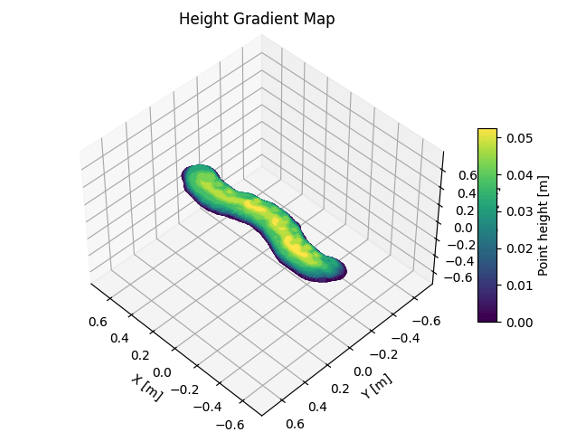
Height map after the second pass: gaps filled, accumulation near the two-layer 0.04 m target.
To test generality, we applied the planner unchanged to an asymmetric J-shaped structure: 97.2% coverage with 8.2% overspray, the same emergent sweep along the spine, and uniform height near target.
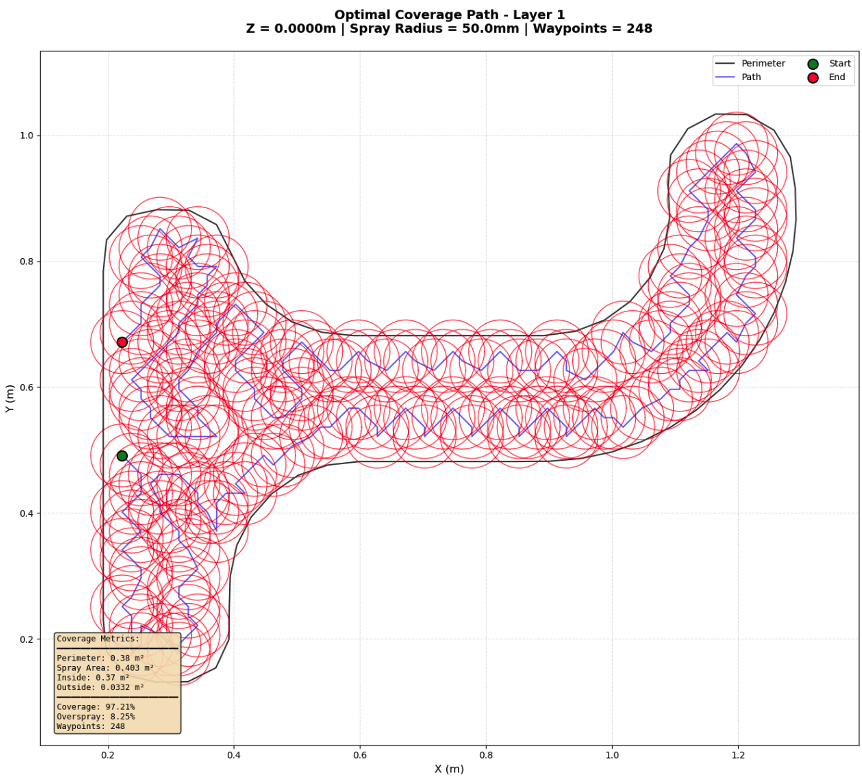
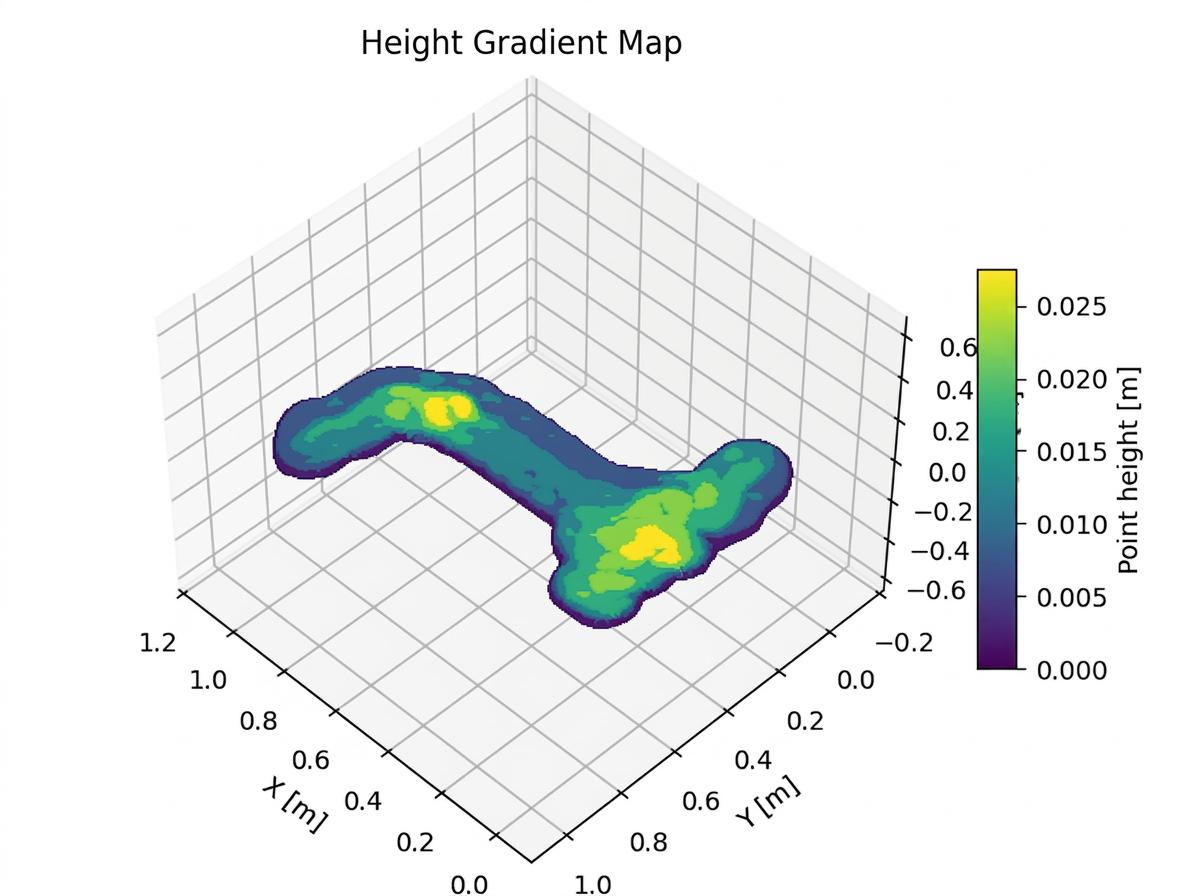
Generalization to a non-symmetric J-shape without parameter tuning.
Conclusion
An overspray-penalized hierarchical search proved a strong fit for spray coverage: relative to the lawnmower baseline it cut overspray by more than half, halved the waypoint count, and held deposited height near the layer target, and it generalized to an irregular geometry without tuning.
The limitations point directly at my current research. The planner assumes each new layer starts from a flat substrate at nominal height, so deposition errors compound across layers, and the fixed downward nozzle cannot print around internal obstructions such as reinforcement bar. Velocity adaptation driven by each layer’s simulated deposit and collision-aware nozzle orientation planning, the subjects of my graduate research with Prof. Shimada, address exactly these two gaps.

